

The S1: How the Moon
Inspired Our Most
Ambitious Timepiece
Every watch DWISS has ever made began with a question. For the S1, the question was this: what if time did not move in a straight line? What if the hours travelled the way the Moon travels — in a curve, in an arc, in a path that is ancient and inevitable and nothing like a hand sweeping around a dial? That question became the S1 Wandering Hours. This is how it happened.
The Observation
The Moon does not orbit the Earth in a straight line. It arcs. Its path across the sky over the course of a night — and over the course of a month — is a curve governed by gravity, by distance, by forces that human beings spent thousands of years trying to understand before they finally did.
Most watches ignore this entirely. The hour hand sweeps around the dial in a circle, every twelve hours, the same arc repeated forever. It is functional. It is universal. It has nothing to do with how celestial bodies actually move.
We found that unsatisfying. The S1 began there — with the conviction that a watch face could carry real astronomical logic inside it, not as a complication bolted onto the side, but as the fundamental grammar of the watch itself.
"We did not set out to make a complicated watch. We set out to make a watch that was honest about how time actually moves — and that led us somewhere no one expected."
The Wandering Hours Complication
The Wandering Hours is not a new complication. It has appeared — rarely, and at considerable expense — in the work of a small number of watchmakers over the past century. The principle is elegant: instead of a single hand rotating around a fixed dial, hour numerals are carried on rotating satellite discs that travel across a fixed arc, pointing to the minute scale as they go.
At any moment, the current hour numeral is positioned along the upper arc of the dial, pointing precisely to the minute scale below it. You read the time by reading the position of the numeral — not by reading where a hand points. It is a fundamentally different relationship between the object and the information it carries.
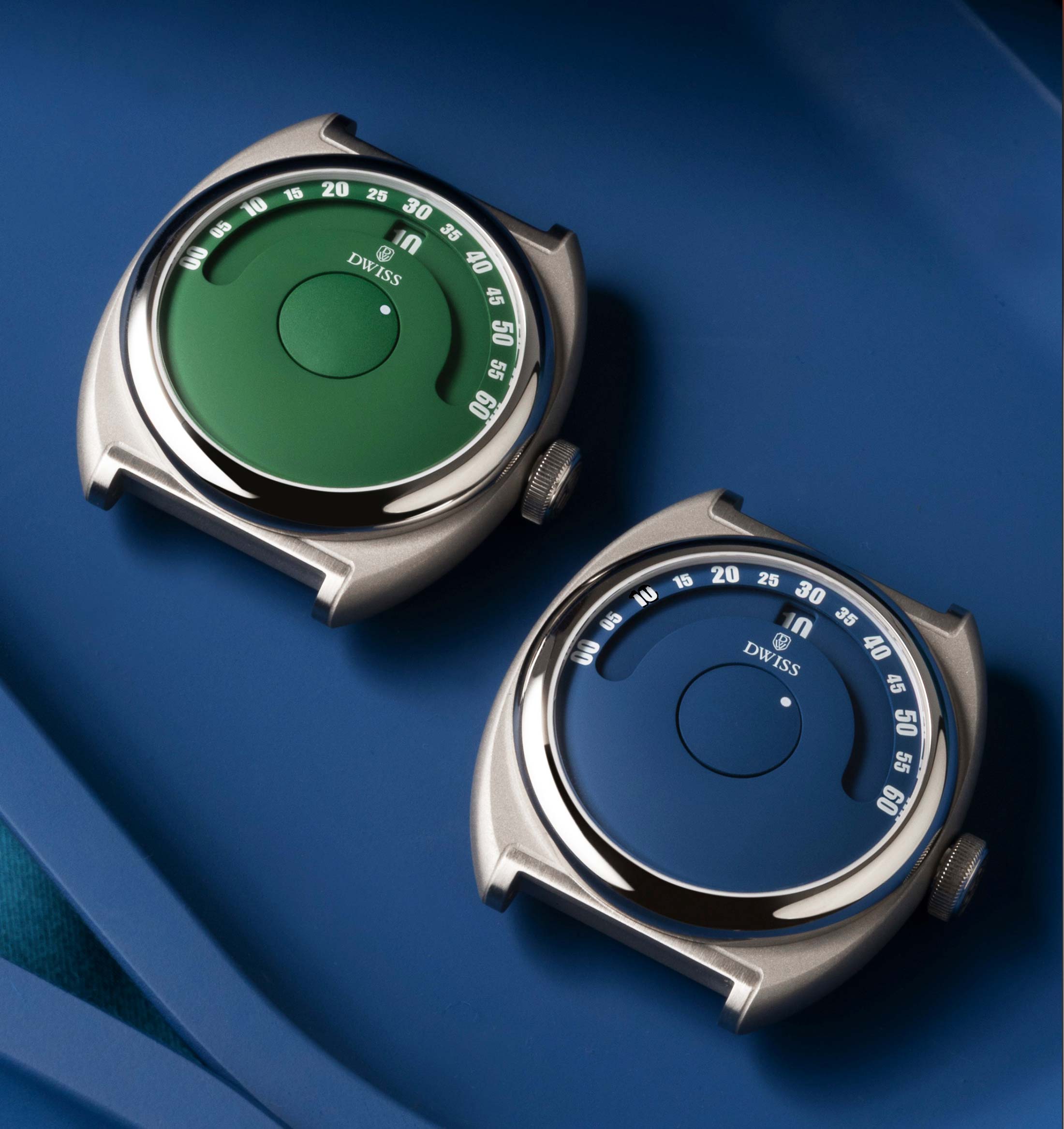
What DWISS brought to this complication was a specific interpretation. The arc on the S1 dial is not arbitrary geometry. It is a deliberate reference to orbital motion — the path of the Moon across the sky. The two satellite discs that carry the hour numerals trace a path that echoes the path of a celestial body moving under the influence of gravity. Time does not move in a straight line on the S1. It travels.
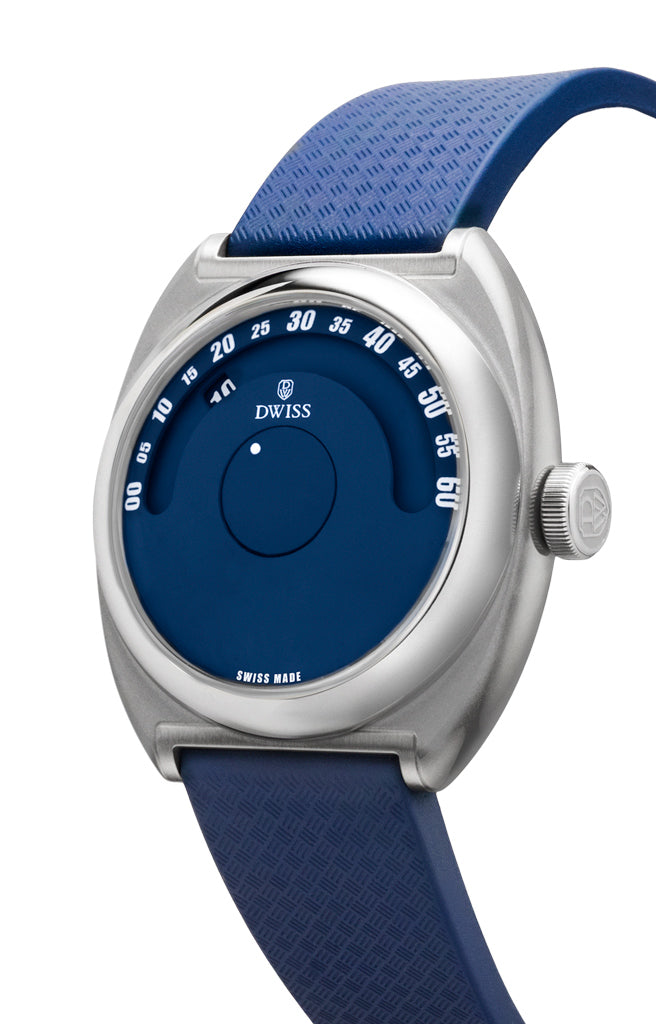
The S1 dial — two satellite discs arc across the upper half, tracing the path of the Moon
The Case: A Cushion as Architecture
The wandering hours complication determined the shape of the watch. An orbital arc needs space — the dial had to be wide enough to allow the hour numerals to travel meaningfully, and the case had to frame that travel without competing with it.
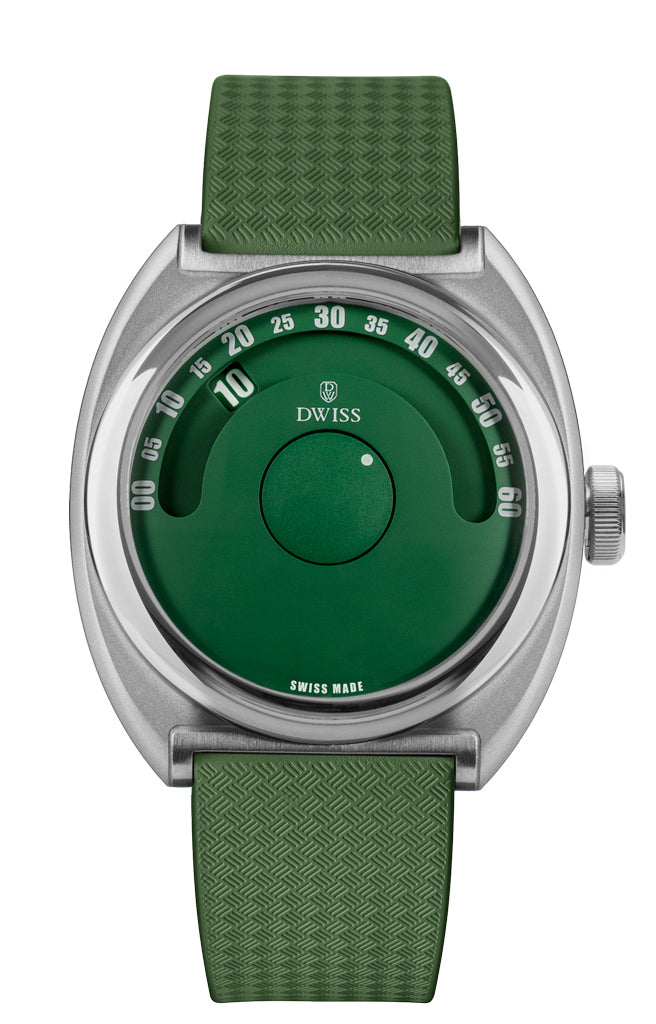
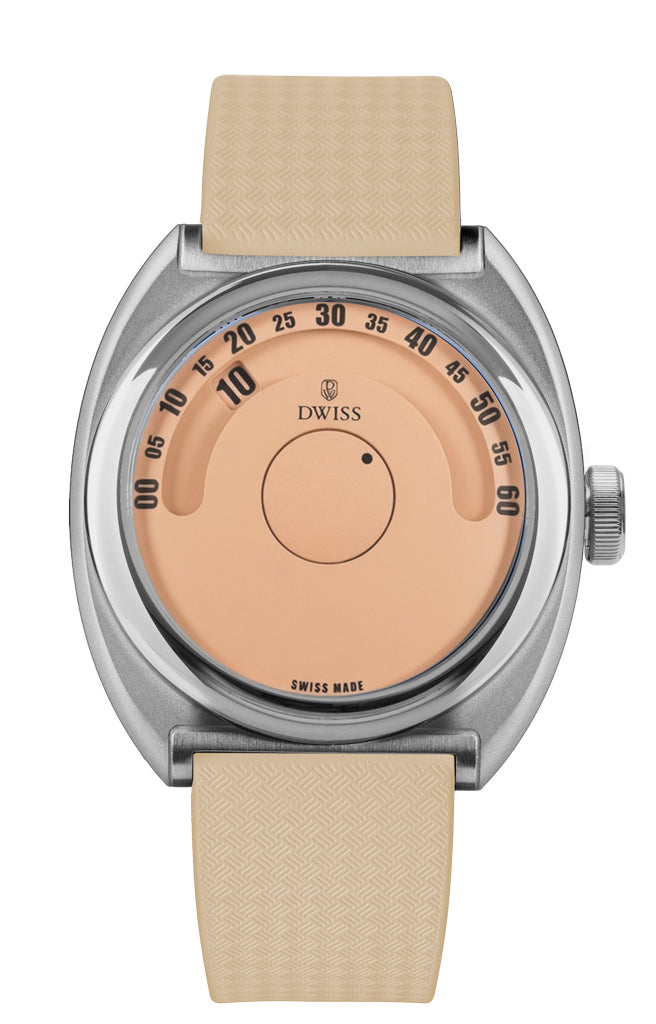
The cushion shape was the answer. It gives the dial the horizontal width that the arc requires, while the rounded corners prevent the watch from feeling oversized on the wrist. The 316L stainless steel case is sand-blasted across the main body, with brushed lugs — a distinction that separates the wearing surfaces from the case body without resorting to polished chamfers. It is a finishing decision that rewards close inspection.
The seconds are displayed on a central disc that follows the shape of the cushion case itself — a subtle geometry that ties the dial to the case in a way that feels inevitable rather than designed.
The Movement: Modified by DWISS
The Wandering Hours complication does not function with a standard movement. The satellite discs require a modified gear train — a mechanism that drives two discs in sequence, each carrying a set of hour numerals, with the transition between discs happening precisely at the top of each hour.
DWISS worked directly on the La Joux-Perret G100 Soigné base movement to develop the proprietary module that drives the S1. The G100 Soigné is already a movement of exceptional quality — Swiss Made automatic, twenty-four jewels, 4 Hz frequency, sixty-eight hours of power reserve, with Soigné finishing that includes Geneva stripes, perlage, and blued screws. The DWISS modification sits on top of this foundation, adding the orbital logic without compromising the underlying quality.
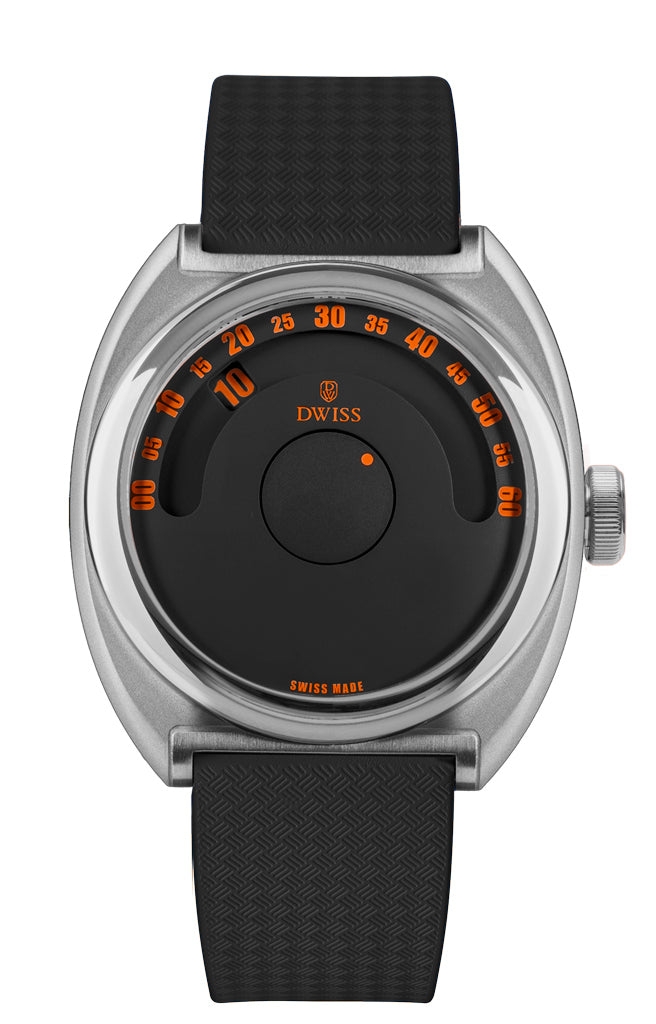
The S1 in Black — sand-blasted case, brushed lugs, sapphire crystal front and back
The Auction: Piece Number 01
At the world debut of the S1 at Time to Watches Geneva in April 2026, piece number 01 was offered at auction. The result confirmed what we believed about the watch — it sold at 30% above retail price, a clear signal from collectors that the S1 occupies a space that is genuinely rare in independent watchmaking: a complication, a design story, and a price point that make sense together.
The remaining pieces are available at the standard retail price of CHF 2,200. Once the fifty pieces of each colour are placed, that colour closes permanently.
Fifty Pieces. Four Colours. No Second Run.
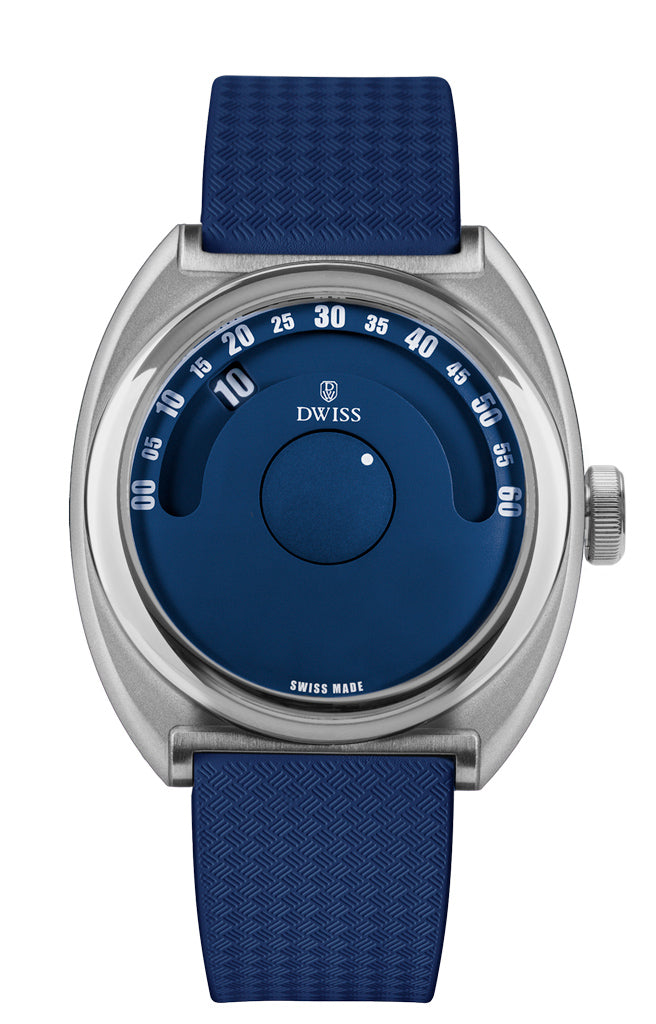
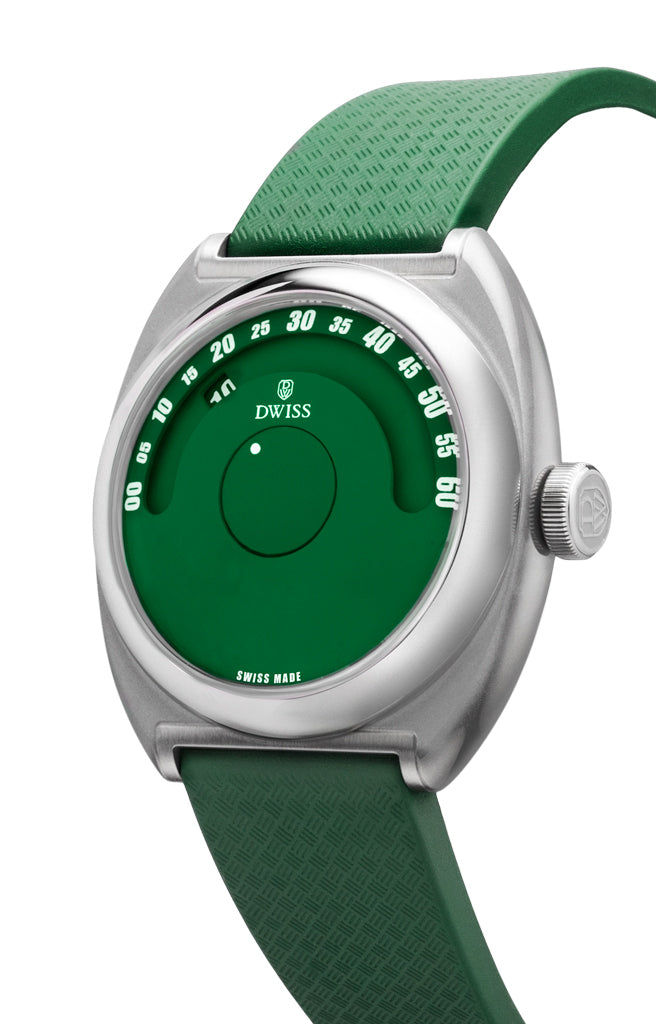
The S1 Wandering Hours is available in four colours: Blue, Green, Salmon, and Black. Each colour is limited to fifty pieces, individually numbered. Once the fifty pieces of each colour are placed, that colour closes permanently. There is no waitlist, no reissue, no second production run.
Condividi:
DWISS Joins the SIWP